Showing posts with label Elimination reaction. Show all posts

Thursday, January 30, 2014

Dehydration of Alcohol

The Dehydration of Alcohol:

Dehydration of alcohol is an elimination reaction which is catalysed by acid.

In this reaction, an alcohol is converted into alkene by loosing water in the presence of acid and the application of heat.


The reaction can be carried out in either of two ways.

·        By heating alcohol with sulfuric acid (H2SO4or phosphoric acid (H3PO4)

·        By passing alcohol vapour over alumina (Al2O3) which acts as an acid) at high temperature


Mechanism:

The reaction takes place in three steps.
  1. Reaction between acid and alcohol gives the protonated alcohol and conjugate base of the acid.
  2. The protonated alcohol undergoes hydrolysis to form the carbocation and water.
  3. The carbocation looses a proton to the base to give alkene.


The rate of dehydration depends upon last two steps; formation of carbocation and loss of proton.


Ease of Dehydration:

The various classes of alcohols differ widely in ease of dehydration. The order of reactivity of alcohols towards dehydration is:

3⁰ > 2⁰ >1⁰

Tertiary alcohols undergo dehydration the most rapily. This is because, they form the most stable carbocations than any other alcohols and once these cations formed they give the most stable alkenes.  


Orientation of the reaction is strongly Saytzeff:

When there is more than one type of β-hydrogens (β1 and β2) in alcohol then there is a possibility of formation of more than one alkene. In such case, preferred alkenes is more stable one, which can be identified by using Saytzeff’s rule. The dehydration of alcohol is strongly oriented to saytzeff rule.

Saytzeff’s rule: According to this rule, the preferred product is that alkene which is formed by removal of the hydrogen from the β-carbon having the fewest hydrogen substitutents.

For example: In dehydration of tert-Pentyl alcohol, two products 2-Methyl-2-butene and 2-Methyl-1-butene are formed.


‘Since there are two types of β carbon (β1 and β2), therefore two alkenes are expected.  
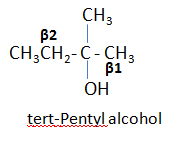

Here β2 is having fewer number of hydrogen than β1, so according to Saytzeff’s rule preferred product is formed by the removal of the hydrogen from β2. Thus 2-Methyl-2-butene is obtained as main product. 

Tuesday, July 30, 2013

Find the total number of alkene

Question: How many numbers of alkenes possible by dehydrobromination of 3-bromo 3-cyclopentylhexane using alcoholic KOH?

Solution:
When any alkyl halide is treated with alcoholic KOH, it removes hydrogen and a halogen atom from it and forms alkene. This is basically a dehydrohalogenation reaction. (You can recall it’s basic from here). The halogen atom removes from the α-carbon and hydrogen atom from β-carbon of the alkyl halide.


 In 3-bromo 3-cyclopentylhexane, α-carbon atom is at position 3 (to which halogen atom attached) and three β-carbon atom which are at 2, 4 and 3 (C of cyclopentane). 


Because of three types of β-hydrogen, there are more than one alkenes are expected.
So let us find out.

11)   Hydrogen remove from cyclopentane i.e. position 3:


2
  2   2) Hydrogen remove from position 2:
Here two alkenes are obtained, one is cis from and other one is trans.


  3) Hydrogen remove from position 4:
Here also two alkenes are obtained, one is cis from and other one is trans.


So the total numbers of alkenes obtained from dehydrobromination of 3-bromo 3- cyclopentylhexane are 5

Dehydrohalogenation reaction

Dehydrohalogenation reaction:

·        It is also called a β-Elimination reaction and is a type of elimination reaction.

  • ·        In this reaction alkyl halide when heated with alcoholic solution of potassium or sodium hydroxide, it undergoes dehydrohalogenation (i.e. removal of hydrogen and halogen) and forms alkene.


  • ·        Dehydrohalogenation involves removal of the halogen atom from the α-carbon and a hydrogen atom from the adjacent β-carbon atom.


  • ·        The relative reactivity of alkyl halide are I > Br > Cl > F (elimination of F is rarely used.) 


·        Chlorobenzene does not react with potassium hydroxide due to the presence of the benzene ring, which, due to stabilization as a result of aromaticity, does not give conventional elimination, as it would lead to a very unstable benzene intermediate.

  • ·        If there is more than one type of β-hydrogens (β1 and β2) in alkyl halide then there is a possibility of formation of more than one alkene. In such case, one of the alkenes is formed as a major product, which can be identified by using Saytzeff’s rule.

Saytzeff’s rule: In a dehydrohalogentaion reaction, the preferred product is that alkene which is formed by removal of the hydrogen from the β-carbon having the fewest hydrogen substitutents.

Example: When 2-bromobutane is heated with alcoholic solution of KOH, it forms but-2-ene (80%) and but-1-ene (20%).


Since there are two types of β carbon (β1 and β2), therefore two alkenes are expected.  Here β2 is having fewer number of hydrogen than β1, so according to Saytzeff’s rule preferred product is formed by the removal of the hydrogen from β2. Thus but-2-ene is obtained as major product.